
The “Historical and Memorial Complex in Memory of the Victims of Fascism,” also known as Hitler’s Werwolf (Wehrwolf) Headquarters, is located near the town of Stryzhavka, about 8 km from Vinnytsia, Ukraine. The museum complex was established in 2011.
Address: Camping tract, Stryzhavka settlement, Vinnytsia district, Vinnytsia region, Ukraine.
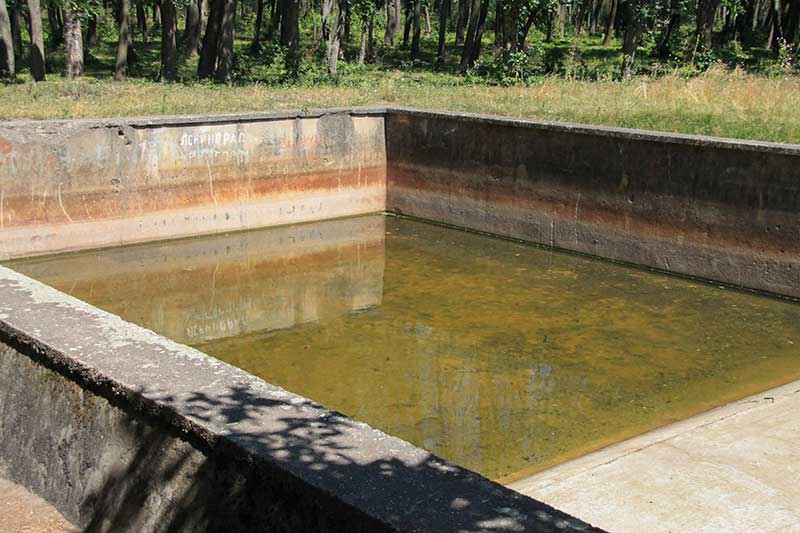
Today, the former headquarters site is a pine forest where large reinforced concrete slabs are scattered throughout the area. All of the bunkers were destroyed by the Germans themselves in 1944. The Finnish wooden houses were also burned down — only the swimming pool survived.
Along the walking paths, there are numerous informational boards explaining what once stood on this site during the time the headquarters was operational.
According to historical documents, Hitler first arrived at the Werwolf headquarters on July 16, 1942, and stayed there for nearly four months with short breaks. His first stay lasted from July 16 to October 31, 1942. The second visit took place from mid-February to mid-March 1943. The last time Hitler visited the headquarters was on August 27, 1943, for only a few hours.
To camouflage the complex, approximately 800 trees and several thousand shrubs were planted. The territory within a 5-kilometer radius was designated a restricted zone, and the surrounding fields were guarded by numerous patrols. A small airfield operated near the headquarters, and a direct daily connection was established between Berlin and Vinnytsia. The site had its own power station and water supply system. There was also a direct telephone line to Berlin, as well as to the headquarters of Göring and Himmler.
In 2016, the guide who led our tour insisted that there were no underground structures on the territory because the headquarters had been built on a granite slab. However, in 2019, new research revealed the existence of underground facilities. The bunker walls were 2.5 meters thick. The complex included a swimming pool supplied with water through pipes from a river 2 km away, a cinema, and a bathhouse. Soldiers and officers lived in wooden Finnish-style houses. Interestingly, some of the cable infrastructure laid during that time is still used by a telephone company today.
I have visited the site twice — in 2016 and again in 2023.
During my 2023 visit, I toured the museum on the grounds. I do not recall it being there in 2016. The museum features a large, detailed model of the headquarters, allowing visitors to understand how the complex looked during Hitler’s time. Unfortunately, due to glare, I was unable to photograph the model.

A general view of the museum interior

Fragments of damaged Soviet monuments were brought to the site and left scattered across the grounds

Since nothing remains of the headquarters site except for the swimming pool, its history is now told through informational boards placed along the paths.
Layout plan of the buildings at Hitler’s “Werwolf” headquarters (1941–1944).

The central part of the “Werwolf” headquarters. In the photographs, you can see the Finnish wooden houses where soldiers and officers once lived.


Reconstruction of the Führer’s residence interior and the air-raid shelter.

The only surviving swimming pool and the remains of the bunkers.